Researchers don’t just need another place to find information. They need a way to discover relevant R&D demand, demonstrate their capabilities, and convert the right opportunity into a project.
01
ARRIVE
A researcher discovers Scinode.
Campaign / Referral
02
SIGN UP
They create a partner profile.
Verify profile
03
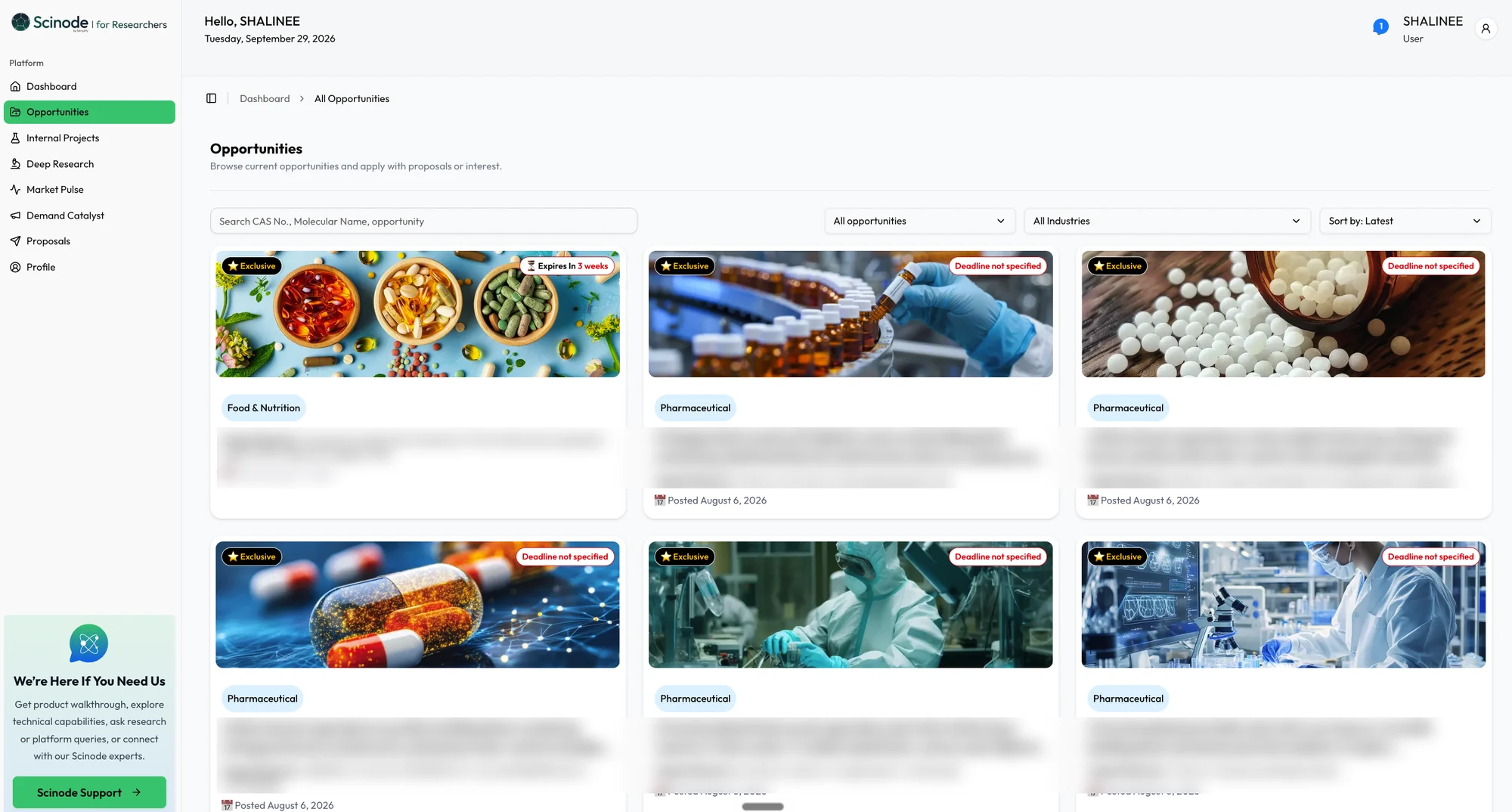
DISCOVER
Relevant R&D demand finds them.
Matched demand
04
PROPOSE
They respond to the right opportunity.
Submit proposal
05
DELIVER
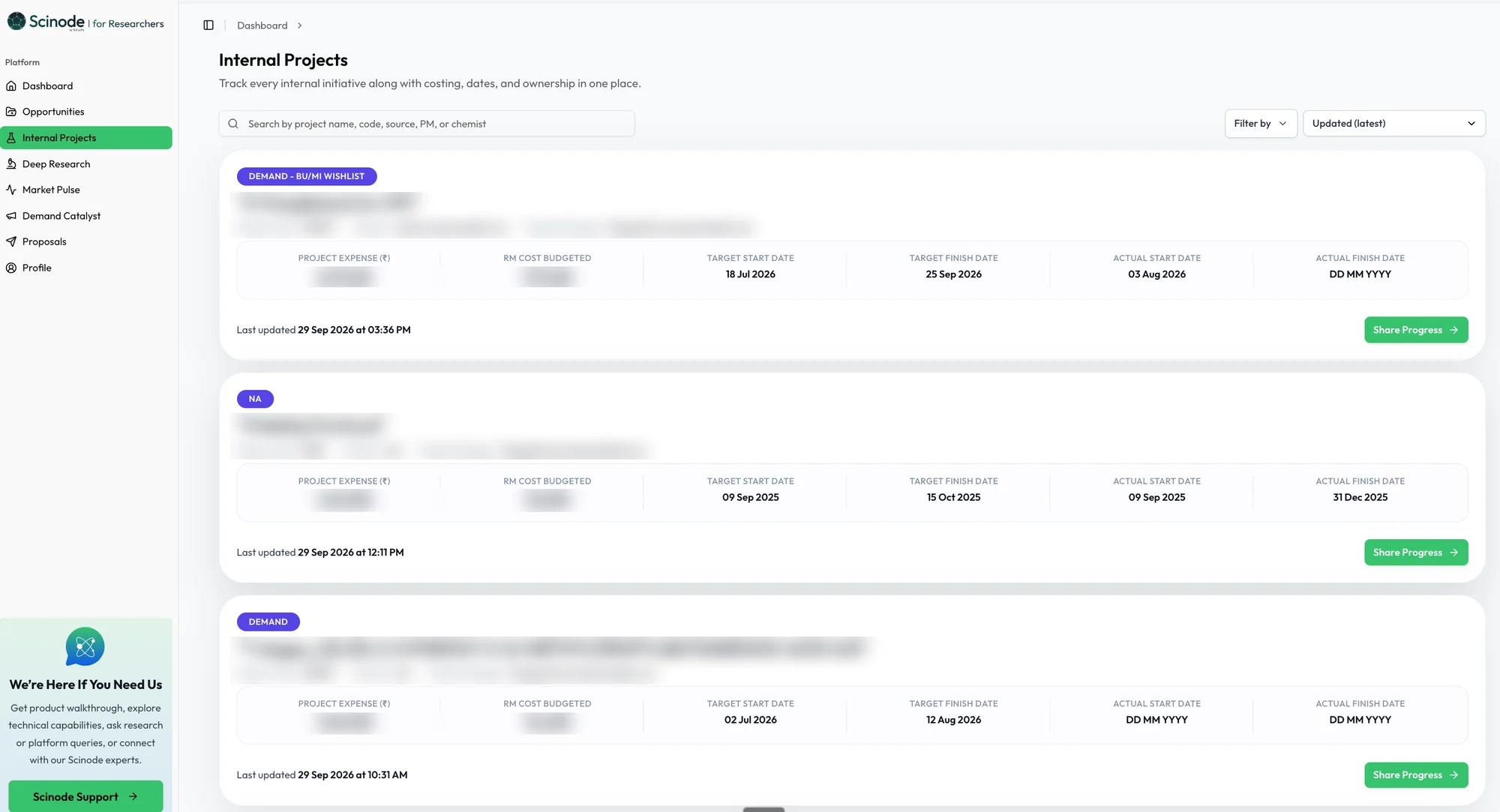
The opportunity becomes a live project.
Project delivery
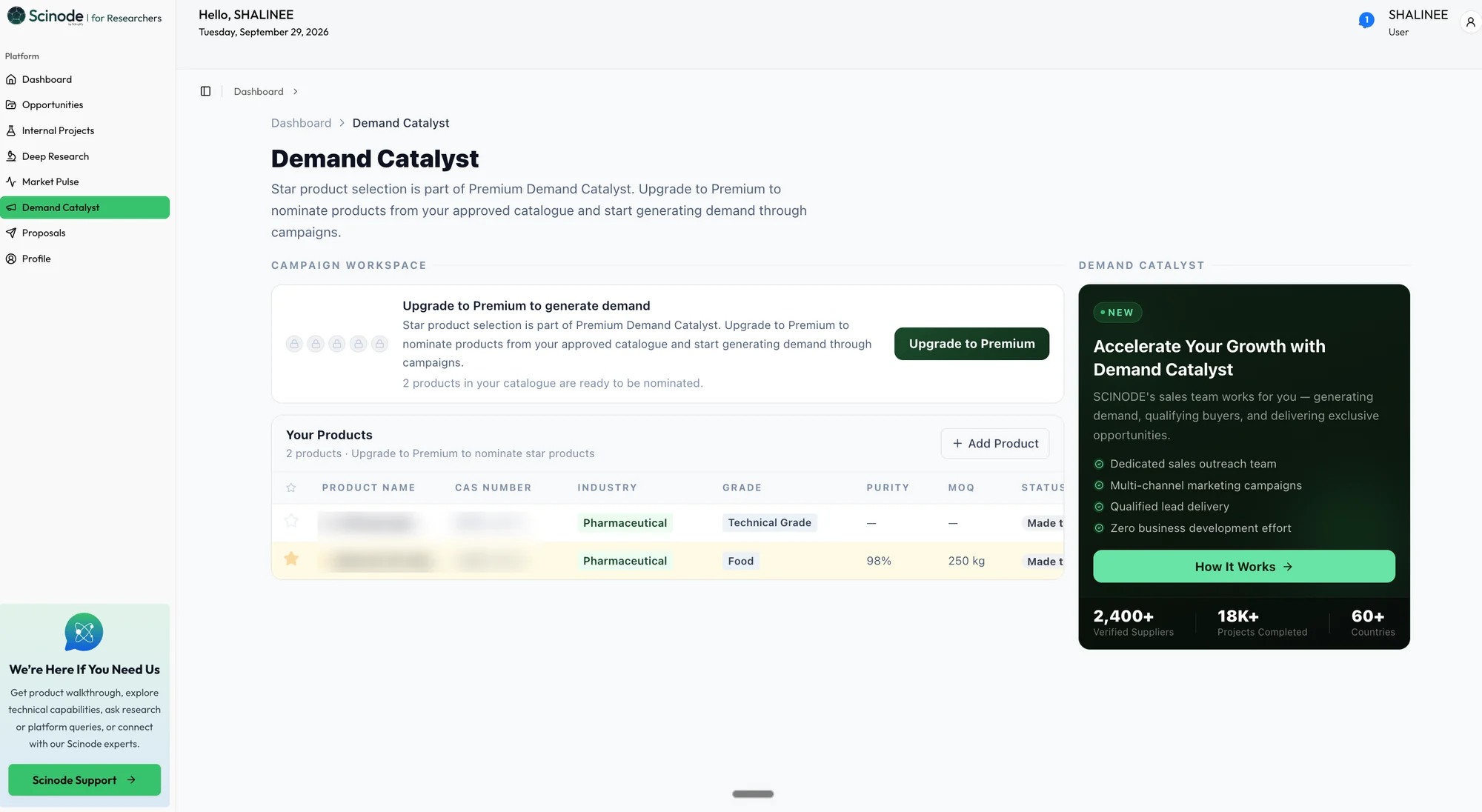
CatalystDemand CatalystMore relevant demand
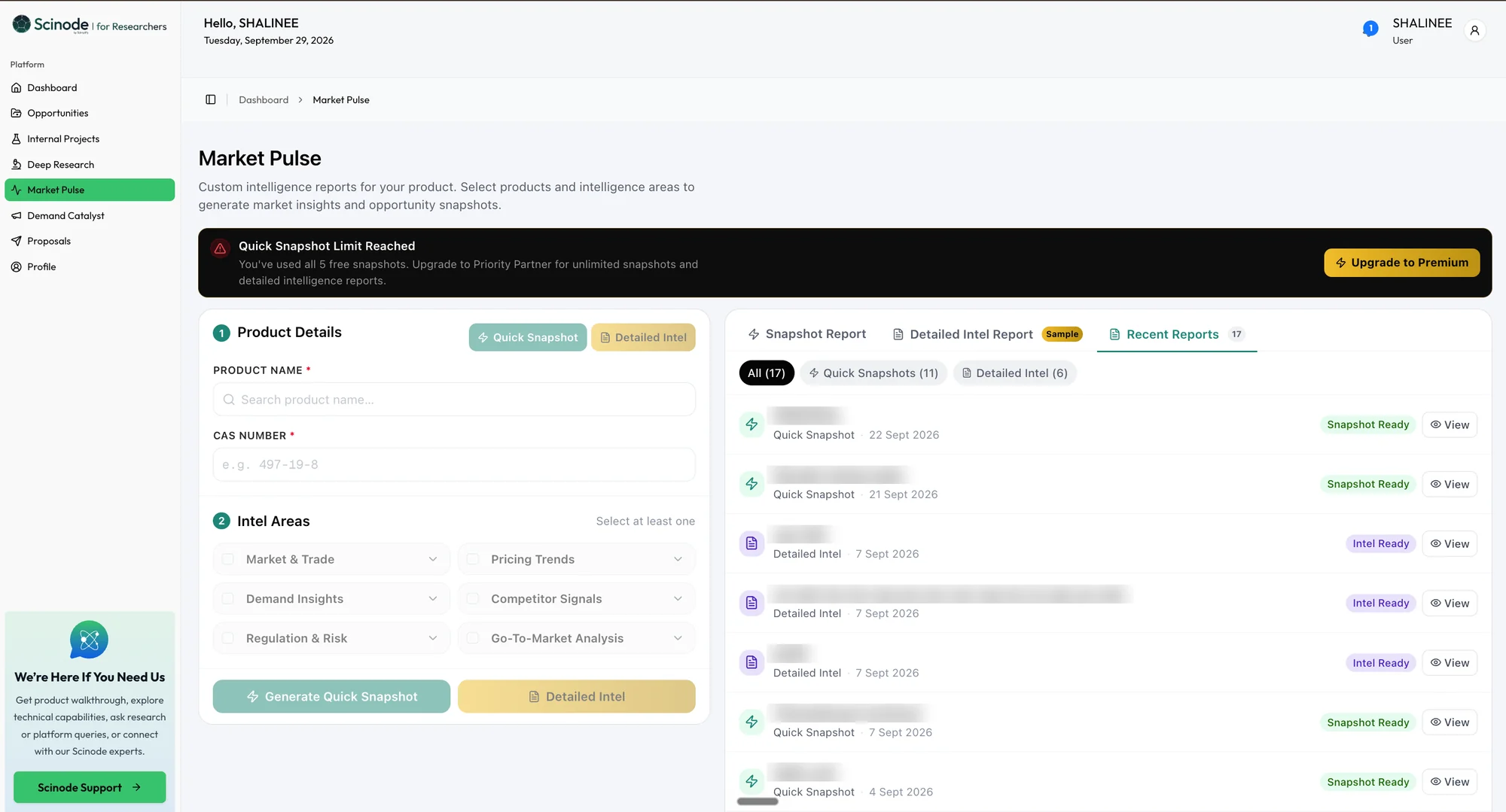
CatalystMarket PulseMore market context
The shift
Instead of making researchers hunt for projects, Scinode brings relevant demand to their expertise.
Match demand to expertise · make the path from opportunity to project simple
The product challenge Create enough value for each side while keeping the researcher experience simple.
Product decisions
01
Product decision
Search → Surfaced demand
Demand before discovery
Instead of asking labs, CROs and scientists to search endlessly for work, we surfaced customer-generated R&D opportunities.
Decision · An opportunity feed based on real demand.
02
Product decision
Generic profile → Capability-based profile
Expertise drives matching
Labs, CROs and scientists needed more than a generic profile.
Decision · Structured researcher and CRO profiles built around capabilities, expertise and experience, so opportunities can be matched to what they actually do.
03
Product decision
Discovery → Delivery
Opportunity, proposal, project
Finding an opportunity isn’t the end goal.
Opportunity→Proposal→Negotiation→Project
Decision · Connect discovery directly to proposal submission and project execution.
04
Product decision
Organic supply → Targeted acquisition
Build the network on purpose
Instead of waiting for organic supply, we actively built the supply side of the network through targeted outreach and institutional campaigns.
Decision · Use targeted researcher acquisition to seed the marketplace.
The funnel I managed
From sign-up to a converted project.
SIGN-UPS
1,000
Researchers who signed up
ONBOARDED
520+
Approved and onboarded. About 52% of sign-ups.
ENGAGED
270+
Viewed a relevant opportunity. About 52% of onboarded.
PROPOSED
190+
Submitted a proposal. About 70% of those engaged.
CONVERTED
50+
Opportunities converted to live projects. About 26% of proposals.
Sign-up wasn’t the metric that mattered. Being onboarded and reaching the first relevant opportunity was.
GTM and launch
Seeding the network
A marketplace needs supply before it can create meaningful matching. We used targeted researcher outreach, institutional campaigns and events to seed the network.
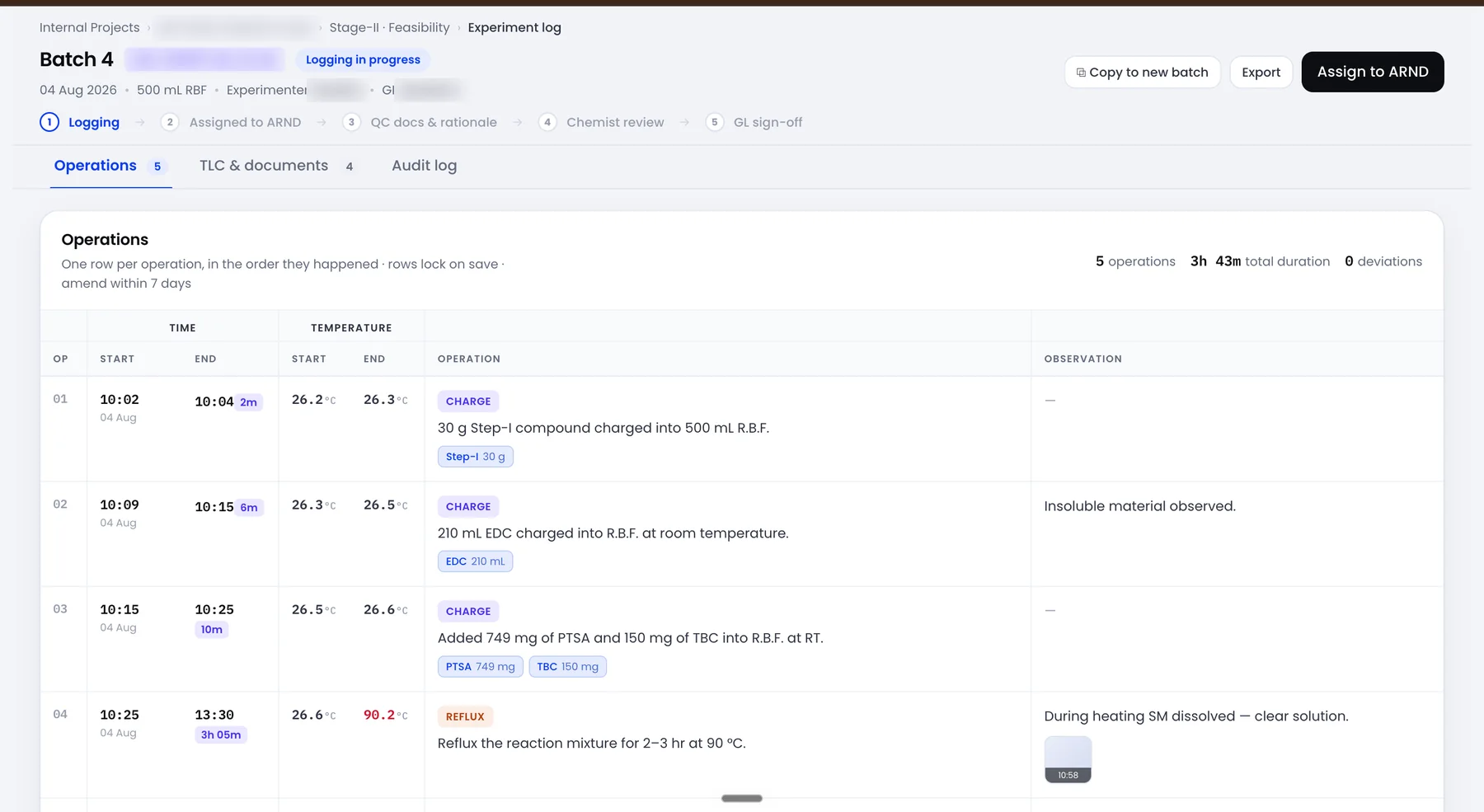
Once an opportunity is converted into a project, the partner tracks the whole project in Scinode and logs experiments hour by hour in the ELN. The ELN also works on its own: a lab or an individual scientist can get it to log a single experiment, or all of a lab’s work, with no Scinode project.
The opportunity and proposal convert into a project once the PO is in.
The partner tracks the entire project in one place.
Experiments are logged operation by operation, inside the project.
On its own
A lab or an individual scientist can get the ELN without a Scinode project.
Log one experiment, or a lab’s experiments.
The same operation-level log, with the same audit trail.
The experiment log: one row per operation, in the order it happened, with time, temperature, material charged and observations. Names and codes are blurred. See how it fits the internal R&D workflow →
Business impact
Turnaround time
−30%
Projects converted
50+
Researchers onboarded
500+
My contribution
I owned the product strategy, researcher experience, activation funnel and GTM execution.
What I learned
01
A marketplace isn’t activated by sign-up.
Onboarding and the first relevant opportunity were stronger signals of researcher activation.
02
Supply quality matters as much as supply volume.
More researchers only create value when their capabilities are structured well enough to match real demand.
03
The first opportunity is the critical moment.
The experience needs to get researchers from “I signed up” to “this project is relevant to me” quickly.
The next evolution is to make matching more intelligent: moving from opportunity discovery toward proactive demand-to-expertise matching.